
Kansas City Solar Panel Cleaning Starts With the Weather
Search for how often solar panels need cleaning in Kansas City and you will get ten answers, most of them some version of “the rain handles it.” That sounds reasonable until you look closely at a roof in Jackson County.
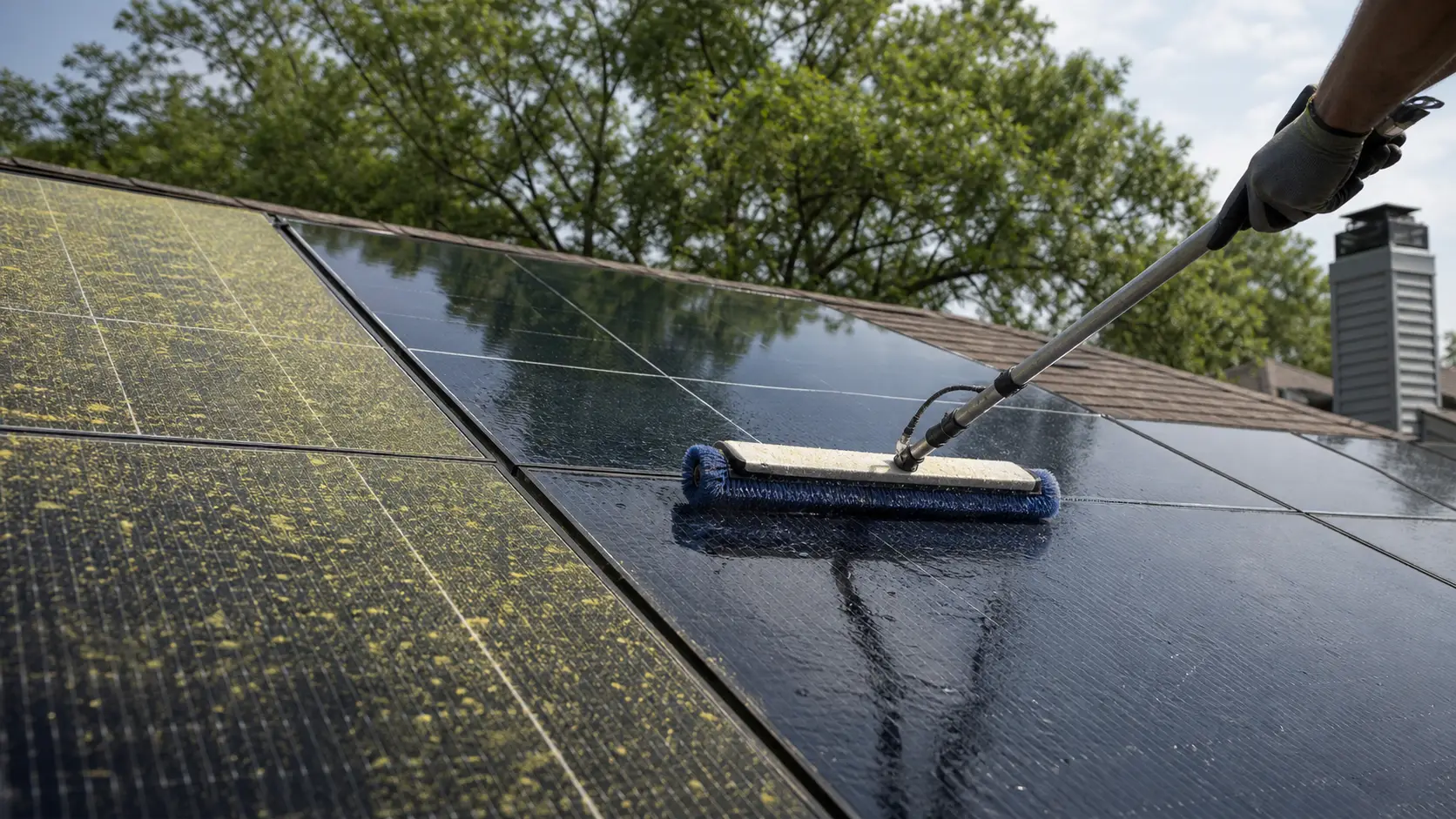
Rain can move loose dust. It does much less against pollen, mineral film, droppings, and the debris that collects along a panel frame.
What Actually Lands on a Kansas City Array
Soiling is not one problem. It arrives in different forms, on different schedules:
-
Spring pollen: Oak and cedar pollen peaks in April and May, and it is sticky. Instead of sliding off with the first shower, it can cling to the glass and give the next layer of dust something to hold onto.
-
Summer agricultural dust: Arrays near tilled ground can pick up a fine mineral film through July and August. It is easy to miss from the ground and stubborn enough to settle into the micro-texture of an anti-reflective coating.
-
Bird and animal traffic: Droppings are more disruptive than a thin film because they are opaque. A small spot across a cell can affect far more production than its footprint suggests. Nesting beneath the array is a separate risk; professional animal guard installation keeps wildlife away from wiring and the underside of the modules.
-
Storm residue: A Midwest thunderstorm may rinse the glass, then leave behind grit, shingle granules, or leaf matter carried by the wind. The lower frame edge is especially good at catching it.
It adds up.
Rain Is Not a Cleaning
Watch what happens after a hard rain. Water sheets toward the bottom rail, slows, and evaporates. Whatever was suspended in that water stays behind as a concentrated line along the lowest row of cells.
That is why a panel can look better from the driveway after a storm and still have bonded residue on the glass. Rain helps. It simply does not replace a proper clean.
The practical test is straightforward: if your array has gone through spring pollen and a full summer without service, it is worth inspecting up close instead of judging it from the ground. If production has also fallen, compare the daily curve with our guide to reading solar production data before assuming dirt is the only cause.
A Realistic Cleaning Schedule
For most homes in the Kansas City metro, this solar panel cleaning schedule is a practical place to start:
-
Once a year after pollen season: Late June through August is a useful window. It clears the spring bond layer before another season of dust settles on top of it.
-
Twice a year for higher-exposure roofs: Consider a second visit if your home is near tilled fields, mature trees, a gravel road, or an industrial site.
-
After a hail event: Treat this as an inspection first and a cleaning second. The point is to document fresh damage or movement while the timing is still clear.
Ground mounts are the outlier. They are easier to reach, but they also sit closer to vehicle dust, mowing debris, and wildlife. Easy access does not automatically mean low maintenance. Solar Scapes’ Kansas City solar maintenance program combines the annual clean with inspection, documentation, and optional production monitoring.
What Cleaning Does Not Fix
Cleaning recovers losses caused by soiling. It does not repair a failing optimizer, a corroded connector, a communication dropout, or a cracked cell. Those are inspection findings, and they can matter more than the dirt. Solar Scapes handles solar panel repair and troubleshooting in Kansas City when the evidence points beyond the glass.
If an array is producing well below expectation, assuming every missing kilowatt-hour is sitting on the glass can waste a season. The wash may help while the actual fault keeps running.
That is why every Solar Shield membership pairs the annual clean with a documented inspection. Silver and Gold add year-round production monitoring, so the visit and the data can point to the same answer. That service history can also matter if you later need to show that you followed your solar panel warranty maintenance requirements.